Showing posts with label game mastering. Show all posts

Sunday, 29 January 2023

#dungeon23 side quest - a Mothership metroidvania

I'm starting a Mothership campaign and it's a good feeling so I have - understandably - been pondering a Mothership megadungeon. Gradient Descent exists. 

The nature of Mothership got me wondering what sort of megadungeon I could create without the traditional levels and loot, and without returning to the surface with treasure, but still with a delving feel and with ramping challenge.

After explaining both Samus Aran and Simon Belmont to my youngest child in the context of Smash Bros, the idea - trying to stay within the bounds of dungeon23 - is to make a 12 area "metroidvania" dungeon and play around with escalating encounter tables and with re-traversing changing areas.

4 conceptual stages, 3 diary pages each. One a month:

Sunday, 22 January 2023

#dungeon23 update. How it started vs how it's going

I switched to using a diary last week; prior to that I had been trying for more of a "one page dungeon" but I got lost in trying to make the flow work around the rooms I was writing, and how to make the rooms fit in the flow I had created.

I thought it would help, but it didn't.

Using a diary (yes I know that was the idea all along) I'm finding that I fill the space with notes, and then stop, and I'm feeling less constrained by the map:

My dungeon23 megadungeon, week 3

I'm still trying to work to the rough proportions from last week but if I can't make it fit then I'm not worrying too much.

Wednesday, 18 January 2023

On #dungeon23 and losing myself in old school dungeon stocking tables

As I have been working on this megadungeon I have been increasingly interested in the old school ways of dungeon generation.  I'm building a location not an "adventuring day". A heavy amount of research has led me to trying to make this first (sub)level 18 rooms large:

Dungeon23 osr dungeon map wip
Progress on level one of my megadungeon

There's differences between systems and authors but an easy generalisation, looking particularly at OD&D and B/X, seems to be that probabilities are something like this: (please do correct or enlighten me in the comments!)

  • 2/6 chance of there being an encounter room (note that in those days, as in my mind, this could mean combat or social encounters) and 3/6 chance there is treasure
  • 1/6 chance of tricks and traps in this room and 2/6 chance there is treasure
  • 1/6 chance of this being a "special room"
  • 2/6 chance of this being an empty room and 1/6 chance there is treasure
This is obviously easily applied to 6, 12, 18, 24 and 30 (and so on) room dungeons, and there were enough people proposing that 18 was a reasonable size for a dungeon level (or here, sub level) that I thought I could aim to fit 18 on the page and see how it went!

How it went was ... OK.  Not as well as I had hoped because I think I have been too focused on making things fit in the context of the map (i.e. "finishing") than getting ideas down on paper (which is more akin to the "beginning" I was aiming to focus on last time!)

However; back to the drawing board and armed with a week-to-page planner/diary I now have a modified plan going forward.  I'm going to stick to the original proposition of just writing rooms but at least I can feel confident that each week long spread of 7 rooms should/could (on average) contain:
  • 2 rooms with encounters, that could be played out by combat or roleplay (best: either)
  • 2 "special" rooms with puzzles or traps or some sort of set-piece
  • 2 empty rooms - although hopefully these will still contain enough dressing to be interesting or relevant
  • 1 wildcard (any of the above, it's just guidance after all)
Generally, 1/4 to 1/3 of these rooms should have treasure (so say two, on average) and this treasure is generally most likely to be "guarded" (by an encounter or a trap) than "unguarded" - but searching empty rooms should prove to be rewarding sometimes!

I'm happy with my progress and what I've learnt so far, how's everyone else getting on?


Friday, 6 January 2023

Beginnings: #dungeon23, 2023 in gaming, and 2023 in blogging.

It's a time for beginnings.  My - lapsed - group and I am beginning a new campaign and beginning tabletop gaming together after a long period of doing other things. I have begun working on #dungeon23, as a personal challenge to get more productive geeking done more than anything else.

I rolled "Artisan Mines" on my hastily constructed dungeon themes spark table and felt I could run with it:
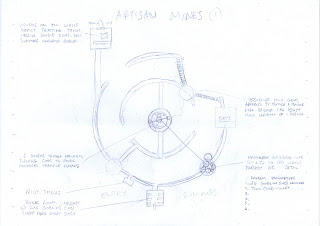
The beginning of Level 1...

The challenge is to write a 12 level, 365 room megadungeon - one room a day. I find that somewhat intimidating so I'm aiming to average a room a day and still try to do a level a month.  Some may be big, some will be small - I suspect August's and December's won't exist - but my aim is to share one level each month here for all of 2023.  Fingers crossed. Beginning to blog again.

I spent a lot of time panicking, mainly about what to build and how to stock whatever dungeons I did build, but I think I'm settled down now.

I found a great tool for "cyclic dungeon generation" on itch.io which has been a boon for inspiration about shape and flow.  I searched for the old school tables for dungeon stocking but found a rule of thumb that - back in the day - dungeon level = monster level = hit dice that I like, so I'm riffing off of that for encounters. I found so many resources about treasure, and that treasure is so different between systems, that I'm going abstract with it so the details can come later.

These are my dungeon beginnings:

  • Room: Dilapidated dormitory. 2d6 [goblins] asleep here on any given shift.
  • Room: Shelves cut into the walls hold gems (major treasure) seemingly arranged by texture and flavour.
  • Room: Privy. Smells bad. (I'd had a busy day)
  • Room: 2 yoked golems trudge mindlessly, endlessly, on a circular path turning the machinery via cogs and shafts.
  • Room: Empty. Carvings on all walls depict feasting trolls. Large double doors, locked and barred from this side. Bell calls a single [goblin?] wearing overalls and fancy hat.
  • Room: Short cut? But far too dangerous to pass through when machinery is turning.

I had planned to begin thinking more about dungeon and adventure design way back last year for the RPG Blog Carnival. That panic that I overcame by beginning was what meant I never began this before, despite wanting to for so long. I needed a push to start before I felt I was ready, 'cos I was never going to feel I was ready otherwise!

Coincidentally, this month's RPG Blog Carnival theme is beginnings. That struck the chord to begin work on #dungeon23, and begin a new campaign, and motivated me to begin blogging again.

So, this beginning technically has its beginnings in the Carnival. Signups are open for hosts for 2023 so why not check out the RPG Blog Carnival hub on Of Dice and Dragons and consider beginning to join the Carnival if you're an RPG blogger?

I'll be beginning a new campaign soon, most likely Mothership. I will be beginning to play Warcry this year too, and maybe Blood Bowl again. That means I'll begin painting minis again too.

Let me know your beginnings in the comments? Whatever you begin in 2023 I wish you well.  Sometimes beginning is the most important thing.

Thursday, 17 February 2022

Running 5e as OSR: Monsters by HD not CR

Some of my friends love 5e, only play 5e, only will play 5e. I find 5e unwieldy and time consuming to prep and run, whereas I love the flow of OSR and PBTA games. But 5e has been around for nearly a decade and apparently isn't going away soon either.

What I want to know is whether I can run 5e for them, RAW or RAW-ish, in a way that means I a) don't have to bog myself down in encounter building and all that crap and b) can use all the cool OSR stuff I have lying around.

Encounter building is painful; it sucks all the joy out of running a game for me. However, embracing "Combat as War, not Sport" I'm sacking off encounter building for good so I don't need CR. What I could do with, however, is an idea of general stats against Hit Dice in 5e so I can use OSR resources or eyeball stats in play.

Sunday, 25 July 2021

My Gaming Notebook (or how I am learning to embrace order)

Let's start by saying I lean somewhat toward Chaotic. My notes, traditionally, are scribbled on margins, envelope backs, and other blank spaces sighted within my apathy radius.

I also have real difficulty with parsing text or writing while I'm talking or listening.

In that context, let's talk about July RPG Blog Carnival topic of "The Gamer's Notebook".  This post sat in my drafts since the beginning of the month as I wanted to take the opportunity to actually think about what I should be doing and if my emergent process is actually any good.

As a GM:

When I run a game I have started trying to keep separate reusable reference sheets for different things depending on their purpose and just reference the ones I need that session. I dread flicking through monster lists at the table as much as I do looking backward and forward in a published adventure looking for a certain piece of information.

Generally I'll want to have:

Wednesday, 9 December 2020

(When) is it OK to TPK?


Total Party Kill. Game Over. The Bad Guys Win.

I don't know how I feel about a TPK in RPGs, and I suspect I'm not alone in that. This month's RPG Blog Carnival at Rising Phoenix is all about When The Bad Guys Win, so I'm trying to get my feelings down on what happens when the Good Guys lose.

Character death is part of the stakes of a lot of our games.  It keeps us on our toes as players. Hitpoints or harm are often one of the resources players have to manage.  There can be a great deal of drama - and satisfaction - in epic battles against overwhelming odds, even if we lose.

Monday, 23 September 2019

Populating the RPG Planning Grid, or Filling Your PANTS

Let's imagine I'm starting my new campaign, and to keep prep low and help tie all the emerging plotlines together I'm using my 5x5 grid of Places, Antagonists, NPC's, Things, and Scenes.

Image (cc) AsymmetricButterfly
I need something going on in the background, so I'm just going to roll up a random plot arc:

Crafted long ago by Lizardfolk, from the bones of a gargantuan beast to be wielded in a war against Undead, this is a spear of destiny. It makes the wielder speak in the language of the creator until attuned and is well balanced, or somehow blessed or guided, adding +1 to attack rolls. The wielder must avenge the death of the last hero who fell using it to awaken its powers, when it will become a +2 magic weapon that blazes on contact and deals an additional 3d6 damage to the intended enemies

This might be the main plot arc of the whole campaign, or it may never get any screen-time.  It doesn't matter, it matters that it gives me some elements and a vague idea for a story.  The story can (and will) change, but that's cool. That's the point of the grid.  Quickly I scribble some stuff in:

Places The graveyard of the Gargants
Antagonists The massing forces of the Undead
NPCs
Things The Gargantbone Spear
Scenes

Now what about our characters' stories?

Friday, 30 August 2019

Campaign Planning Grids for Plot Elements

I have been playing around with ways to make my planning easier, more dynamic, and more focused.  The idea I've hit upon is mainly inspired by Technoir's "Transmissions" and the sheets I had made to track the Enemies, Friends, Complications, Things and Places for each system in my Stars Without Number campaign.

Image (cc) Sheam Bo
I was using a 5x3 grid for SWN - one for each category for each tag I used, including the Trade tags from Suns of Gold, and it worked well.  However it didn't feel like there was much continuity in terms of the plot, and I was keeping notes elsewhere on what was happening on and off screen. Given that the system is designed for sandbox games that's fine, but in retrospect I think I overplanned here for my needs and should only really have had one of each category for background, side plots, and local colour - but that's for another article...

Tuesday, 30 July 2019

Campaign Planning, Reusability, and Separation of Concern

Some important concepts from my work in computer software can definitely be applied to campaign planning. Let's talk about two of them.
Image (cc) Tim Probert

Separation of Concern

Think of any dungeon* you've seen - or have written - with a map of the layout, lists of encounters for each room, key items and notes on where they are hidden.  How many times have you, as GM, had to skip, rearrange, shuffle or rebuild parts in response to the party's actions? Exactly.

Separating the elements means more flexibility.  Generally, the dungeon map doesn't care what monsters lie within and the monsters don't care what important treasures they guard. So if we plan loosely we can make it easier to change or add things on the fly.

Thursday, 20 June 2019

Railroad / Sandbox / Other - The Third Alternative

Image (cc) Dean Peters
There is a sliding scale between the "Railroad" and the "Sandbox" when it comes to RPG campaigns, and between pre-planned and on-the-fly content.

Railroads are pre-set linear story paths that the players can break by deviating from them; this is the main criticism that tends to be levelled at traditional published adventures.  The storyteller in me wants a beginning, a middle, and an end for my campaign "season" just like a TV season, but I don't want to railroad the players. And I don't want to prep it all up-front!

Sandboxes are environments that let the plots be driven by the players; the GM leaves hooks and clues for them to find but the story follows the players' choices.  The storyteller in me loves this, I love to build in player stories, but I don't want to prep a load of stuff that won't get used and I don't want to wing too much

But these aren't the only structure options, these are just the options we see in modules because they are the options that are easy to publish.  I'm looking for a low-prep option 3.

Tuesday, 11 June 2019

Dynamic RPG Plotting Project

Image (cc) paganjesus
I'm the kind of person who likes to have a project, so I'm setting myself one right here.

For years I've been looking for a way to weave the player characters into engaging plots while still keeping prep low and flexibility high, and it finally feels like things are falling into place. My hobby project for the rest of this year [EDIT: now ongoing!] is going to be formalising my ideas and getting them down on paper. Electrons. Like so:
  1. How I Learned to Let Go and Embrace the Chaos
  2. Railroad / Sandbox / Other
  3. Reusability and Separation of Concern 
  4. Using a Grid for Plot Components
  5. Populating the Grid 
  6. Using the Grid for Planning 
  7. Reshuffling Items in the Grid 
  8. Example Campaign 
Sounds manageable, and by the end I'll know if it works or not. Hope you'll follow along. I'll be using this post as an index as I go and post a retrospective at the end, wish me luck!

Monday, 10 June 2019

RPG Blog Carnival - A Band of Fair Folk

Image (cc) amorphisss
Fae don't seem to feature much in Dungeons and Dragons games (that I have played) and I think it's probably because they're low challenge in combat. But why would faeries, who are essentially physically weak extradimensional magic users, be interested in engaging in combat when they could be playing to their strengths?

By their nature, the Fair Folk are otherworldly, capricious, playful, powerful, and broadly disinterested in us and our world unless they can derive some entertainment or gain.

Here are my thoughts on how to take advantage of this nature to have fun at the table:

Wednesday, 29 May 2019

On DMing, or How I Learned to Let Go and Embrace the Chaos

Image (cc) Kridily
Dungeons & Dragons is a bad game.*  Bad naughty.  It's irresponsible in that it doesn't show us how to be Dungeon Masters - my favourite term for which is Apocalypse World's "MC" as we are, after all, Master of Ceremonies above all else.

D&D teaches us to build encounters, but not how to build stories and worlds.  It teaches us to think in terms of probabilities and not stakes.  I learnt to DM on 4e and I've spent maybe a decade unlearning how it was presented to me then.  It took Stars Without Number and Dungeon World to open my eyes to how a game could be run.

Friday, 17 May 2019

Friday Freebie: Stars Without Number

Image (cc) Phil Parker on Flickr
How could I not recommend the magnificent Stars Without Number as a top tier FREE GAME?

Stars Without Number is the game that changed how I DM.  It helped me prep just enough and forgot about "building encounters" and start enjoying the game so much more. It's the game I wish I'd run first, but more on that later.

But how does it play?

Mechanically, it's an odd mix of d20 (for combat and saves) and 2d6 (for skills) but the players didn't seem to mind.  Skills are distinct enough without being too granular and it all seems to work.  Being an OSR game there are hit dice and hit points, and my favourite method for rolling HP when you level I have seen so far: roll all your hit dice and get that if it's higher than your current total, or get +1 HP if you rolled lower.  It really helps to smooth the curve.

Wednesday, 15 May 2019

Making Skill Checks More PBTA

Image (cc) oxpal
One thing I loved when reading Dungeon World was how all the moves fall into the same basic pattern:
  • 10+ (on 2d6 plus modifiers) means clean success
  • 7-9 means success, but with a cost or limitation
  • 6 or less means failure and the DM moves the story along
It's an easy change from pass/fail and it runs right through all "Powered by the Apocalypse" games.  Note how there's no DC. I like this. So often my players roll skill checks and announce the result before I decide the DC that I end up just eyeballing it - so why not get rid of it? This is all about stakes and not about difficulty.

Sunday, 3 April 2011

Rollin' with it: Piratical feats 'n' treats

Arrrgh! | PiratesImage (cc) Joriel "Joz" Jimenez via Flickr
Yarr!  My Freeport game for Pathfinder is gathering speed - in my head at least.  I've been reading through the Pirate's Guide and getting a handle on the wheels rolling behind the setting.

E6 games need feats, so I got some Combat, Subterfuge and Immediate Action feats from Genuis Guide to keep my players (and NPCs) up to speed.  The "Immediate Action" feats are pretty cool, essentially providing more options for Attacks of Opportunity - throwing weapons and all sorts.

Thursday, 24 March 2011

[Guest] GM Screen: Why You Should(n’t)

Role Playing Gamers at the Burg-Con in BerlinImage via Wikipedia (cc)
I've been playing RPGs for 26 years, and in that time I've seen all kinds of GM screens.  Some really cool (a castle wall, complete with towers and crenellations), and some not so cool (a cardboard box).  In all that time I've seen how they've been both helpful and hurtful to a game.  Regardless of your preference, take a look at some pros and cons of using (and not using) a GM screen.  You might alter the way you game, and be thankful you did.

Why you should use a GM Screen:

Wednesday, 23 March 2011

Rollin' with it: A place to call home...


First decision made:  I'll be running Pathfinder in Epic 6 mode because at least I know what I'm doing and I know my players like the system.

I'll also be going miniatureless - which is unusual for me, but worked well in Alternity and saves a lot of mini-and-map-related hassle!  Go go Gadget imagination.

Second decison made:  We'll be playing in Freeport, for multiple reasons:

Sunday, 20 March 2011

Rollin' with it: The Zero-Prep GM Challenge!


The plan, following my jaunt into free-flowing GammaWorld goodness, is to structure my game-mastering so that:
  • There is no "Adventure Path Railroad" my players have to follow, but there is still structure and plot.
  • The heroes can choose their sides and actions without having to worry about derailing the abovementioned plot-train.
  • I have minimal prep for each adventure / story arc, and can easily take the game wherever the players choose.
  • We can roll dice, have fun, and tell stories without anyone having to write (or, for that matter, READ) pages of story and fluff that may not end up being relevant to the story anyway.  See points 1 and 2.

Please consider indie and small press RPGs, and support the blogosphere.

Image content used that is not original was sourced via creative commons or similar and is used in good faith - and because I love it - however please contact me if there are any issues.